Fear and Distrust Are the Real Russian Plague
Published Not supplied · Discovered 9 Oct, 17:01 UTC · Original language: en · Version 2
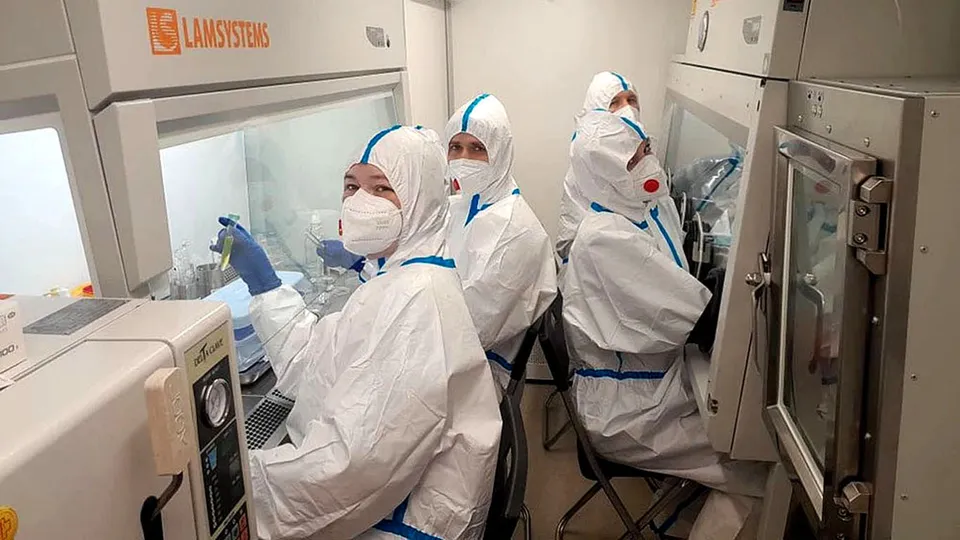
Modern disease outbreaks differ from historical ones for reasons that go beyond vaccines, better treatments and improved hygiene.
Sure, that all helps. But these scientific advances went hand in hand with social transformations that made experts and public health authorities more credible than a local leader or a healer who believed eating the organs of the deceased could save people from the plague.
Trust in science and institutions, sometimes reinforced by figures like a Catholic priest promoting vaccination, allowed technological advances to spark broad societal progress that reached far beyond the educated classes. For years, Western democracies championed the building of trust between citizens and authorities.
Where that trust breaks down, ancient instincts can take over despite the availability of modern medical equipment and treatments.
And there are few words that awaken those instincts like “plague,” especially when it appears alongside the word “Russia” in 2026.
So why is this apparently isolated suspected case resonating with people far from the Anti-Plague Research Institute of Siberia and the Far East in Irkutsk?
There is nothing particularly Russian about laboratory-acquired infections, one possible explanation that has been raised in this case. Even if we set aside the contentious debate over the origins of Covid-19 and focus only on plague, a researcher in the United States died from a laboratory-acquired infection in 2009.
The publicly available database of laboratory-acquired infections maintained by ABSA International, the biosafety association, is impressively long and mostly limited to lab personnel. Researchers are human beings who can make mistakes. Those studying dangerous pathogens risk, first and foremost, their own lives in pursuit of medical progress (or for military purposes, but we should not presume that is the case here).
What is different between Russia and the U.S. is what happens after a suspected laboratory infection. Here there is something distinctly Russian or, better yet, something distinctly Russia-in-2026.
A prolonged political crisis inevitably brings a crisis of trust. In 2014, Russian authorities denied state-sponsored doping at the Sochi Olympics and the presence of Russian troops in Crimea and the Donbas.
The state’s undercounting of Covid-19 deaths in 2020-2021 was followed by the approval of vaccines before large-scale clinical trials were complete, which resulted in the approval of one vaccine that does not work at all and another with adverse effects.
After the full-scale invasion of Ukraine, official sources appeared to inhabit a parallel reality, denying responsibility for civilian deaths, concealing mobilization plans and withholding the scale of military losses.
It’s no surprise that official assurances about the suspected plague case in eastern Siberia have been met with doubt, both locally and internationally.
World Health Organization Director-General Tedros Adhanom Ghebreyesus has said the organization lacks the information needed for a full risk assessment. He has also sought clarification about reports of a second employee with unexplained pneumonia, whose existence is denied Russian authorities deny.
His concern is more than a matter of curiosity. A lack of transparency undermines the foundational rules that allow the WHO to help countries combat disease. The WHO’s 2024 manual for plague surveillance, diagnosis, prevention and control treats communication as an integral part of outbreak control, not an add-on.
Under the International Health Regulations, countries must notify the WHO within 24 hours of assessing an event of potential international concern. Suspected pneumonic plague must always be assessed using the regulations’ decision instrument, and a suspected case outside a known endemic area should be reported without waiting for lab confirmation.
These requirements provide a starting point for protecting communities. Effective public health measures also depend on communicating risks, addressing misinformation and involving communities in the response.
None of these measures are possible without transparency and a willingness to address the concerns of local populations. Without reliable information, people may become extremely worried, creating conditions for unrest or a witch hunt. Or they may become recklessly complacent. In both cases, societal turbulence might become more dangerous than the disease itself.
There is also nothing particularly Russian about studying infectious agents for both civilian and military purposes. Many powerful countries have explored this path, says Natalia Rapoport, a professor emerita in the University of Utah’s biomedical engineering department.
The daughter of the prominent Soviet pathologist Yakov Rapoport, she recounts his memoirs of performing an autopsy on Abram Berlin, a victim of a lab-related plague outbreak in Moscow in 1939.
She explains how fear of the plague becamed intertwined with fear of repression. Her father feared arrest, which eventually came more than a decade later. When he was taken to the plague hospital, he called her mother and said: “Don’t worry, it’s not what we were afraid of. It is just the plague.”
The plague is not just a bacterium. It is also a social phenomenon. And how much devastation and fear it brings depends on how well our society functions, not just a group of prepared experts.
Alexandra Borissova Saleh

Alexandra Borissova Saleh
We are facing unprecedented challenges. Russia's Prosecutor General's Office has designated The Moscow Times as an "undesirable" organization, criminalizing our work and putting our staff at risk of prosecution. This follows our earlier unjust labeling as a "foreign agent."
These actions are direct attempts to silence independent journalism in Russia. The authorities claim our work "discredits the decisions of the Russian leadership." We see things differently: we strive to provide accurate, unbiased reporting on Russia.
We, the journalists of The Moscow Times, refuse to be silenced. But to continue our work, we need your help.
Your support, no matter how small, makes a world of difference. If you can, please support us monthly starting from just $2. It's quick to set up, and every contribution makes a significant impact.
By supporting The Moscow Times, you're defending open, independent journalism in the face of repression. Thank you for standing with us.

Remind me next month
Full text reproduced from themoscowtimes.com (publisher page, rights-checked under syndication).
View original at themoscowtimes.comAbout this report
Original title: Fear and Distrust Are the Real Russian Plague